How to Create Your Ideal Week as a Lawn Care Business Owner

Monday morning, you have a plan. By 9:15, a mower is down, a customer is upset about a missed spot, and two crew members called in. By Friday, you've worked 60 hours, but the marketing, hiring, and planning you meant to do never happened. Again.
Sound familiar? You're not lazy, and you're not bad at business. You just don't have a week built on purpose. Your week is built by whatever yells the loudest.
That's what an ideal week fixes.
What Is an Ideal Week?
An ideal week is a template for how your week should look when you're running your business well. It's a calendar built in blocks that gives the most important work a protected spot, before the urgent stuff fills every gap.
It's not a rigid schedule you'll follow perfectly. Weather happens. Equipment breaks. But when you have a default plan, you can adjust it instead of starting from zero every Monday. And when something knocks you off course, you know exactly what to get back to.
In our time management post, we covered the four realities every lawn care owner needs to accept:
You won't manage your time well until you change your identity.
Everyone gets the same 24 hours.
Work expands to fill the time you give it (Parkinson's Law).
There will always be too much to do.
An ideal week is how you put all four into practice. Here's how to build yours.
How to Build Your Ideal Week in 6 Steps
Step 1: Brain dump every task into four buckets
Grab a sheet of paper, draw four columns, and write down everything you do as the owner. Don't organize it yet. Just get it out of your head.
Critical tasks: The work that actually grows your company. Marketing, sales follow-up, pricing, reviewing your numbers, and planning.
People tasks: Your team meetings, one-on-ones with crew leaders, hiring, and relationships in your community, like the guy who sells tractors down the road.
Professional development tasks: How you're growing as an owner. Coaching, business programs, podcasts, books.
Paycheck tasks: The day-to-day work you do to earn your salary. Invoicing, admin, scheduling, routine calls.
For most owners, the paycheck column is the longest, and it's the one eating the week. Critical tasks get knocked to the side because paycheck tasks end up treated like the priority, even though they shouldn't be.
Step 2: Block your non-negotiables first
Before a single work task goes on the calendar, block out what matters most outside of work. Dinner with your family. Tucking your kids in. Church, the gym, date night.
This isn't soft stuff. How you manage your time decides whether you make it home for dinner. If these aren't on the calendar first, work will happily take their place.
Step 3: Put critical tasks in your best hours
Critical tasks are the ones that grow your company, so they get your best energy, not your leftovers. For a lot of owners, that's early morning before crews roll out, or a set block one or two mornings a week.
Treat these blocks like an appointment with your most important customer. Because they are.
Step 4: Schedule your people on purpose
If you only talk to your team when something breaks, you'll lose good people. Give them a regular spot on the calendar: a standing weekly team meeting and recurring one-on-ones with your crew leaders. Investing in your people is how they stay for years.
Step 5: Protect time to grow
Professional development is the easiest thing to push to "someday." Give it a recurring block, even if it's just an hour a week. The business can only grow as fast as you do.
Step 6: Batch your paycheck tasks and set a time limit
Here's where Parkinson's Law works in your favor. Instead of answering emails and doing invoices all day, batch them into set blocks and give each block a hard stop. If invoicing gets one hour on Monday and Thursday afternoons, it will usually take one hour.
And as you look at that paycheck column, ask yourself which of these tasks could eventually be handed off. That's how you work your way out of the role over time.
Bonus: leave room for fires
This is lawn care. Things will go sideways. Build in a buffer block or two each week so one surprise doesn't wreck the whole plan.
What an Ideal Week Can Look Like
Every business is different, so use this as a starting point, not a rulebook. Here's a sample in-season week for an owner who's still in the field part of the time:
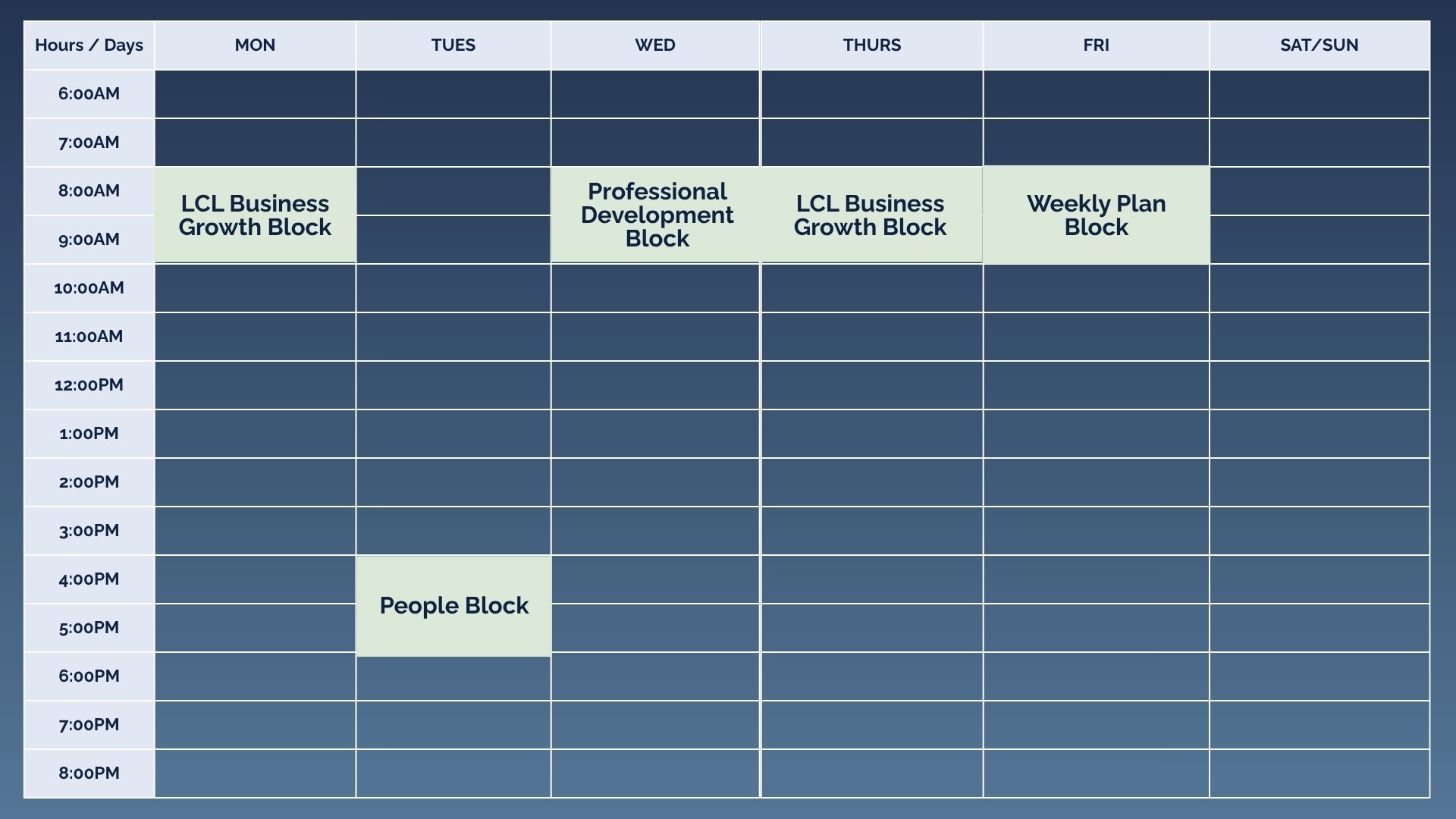
Notice what's happening. Critical tasks get protected. People tasks have a set home. Paycheck tasks are capped instead of spreading across every day. And Friday ends with a plan for next week, so Monday doesn't start with chaos.
In the off-season, you can flip the ratio and give critical and professional development work much more of the week. Winter is the perfect time to build the systems that make your spring ideal week possible.
How to Make Your Ideal Week Actually Stick
Building the calendar is the easy part. Living it is where most owners slip. A few things that help:
Ask the identity question. When you're tempted to drop a critical block for something that feels urgent, ask: "What would a business owner who manages their time well do right now?" Then do that.
Expect imperfection. There will always be too much to do. Some weeks will fall apart. The goal isn't a perfect week. It's getting back to the plan faster each time.
Review it weekly. Spend 15 minutes on Friday looking at what worked and what didn't. Adjust the blocks, not the priorities.
Share it with your team. When your crew leaders know Tuesday morning is your marketing block, they'll learn to save non-urgent questions for later.
Get some accountability. It's a lot easier to protect your time when someone else is checking in on whether you did.
Frequently Asked Questions
What is an ideal week for a business owner?
An ideal week is a calendar template that shows how your week should look when you're running your business well. It protects time for the work that grows your company, your team, your own development, and your family, before admin and daily fires fill every gap.
How do I create an ideal week calendar?
List every task you do and sort it into critical, people, professional development, and paycheck tasks. Block your personal non-negotiables first, put critical tasks in your best hours, schedule team time on purpose, and batch admin work into time-limited blocks.
What is time blocking?
Time blocking means assigning specific blocks of time on your calendar to specific types of work. Instead of reacting all day, you decide ahead of time when each kind of task gets done.
How should a lawn care business owner structure their week?
Protect a few blocks each week for growth work like marketing, sales, and reviewing your numbers. Give your team a regular meeting time, batch invoicing and admin into capped blocks, and leave buffer time for weather and equipment issues.
Become the Owner Your Business Needs
Your ideal week isn't just a calendar. It's a picture of the business owner you're becoming: someone who leads the company instead of getting dragged around by it, and who still makes it home for dinner.
If you want help building your ideal week, plus the systems that let you actually live it, let's talk. Book a free 30-minute call with the Lawn Care Launch team, and we'll look at where your time is going and what it would take to get it back.